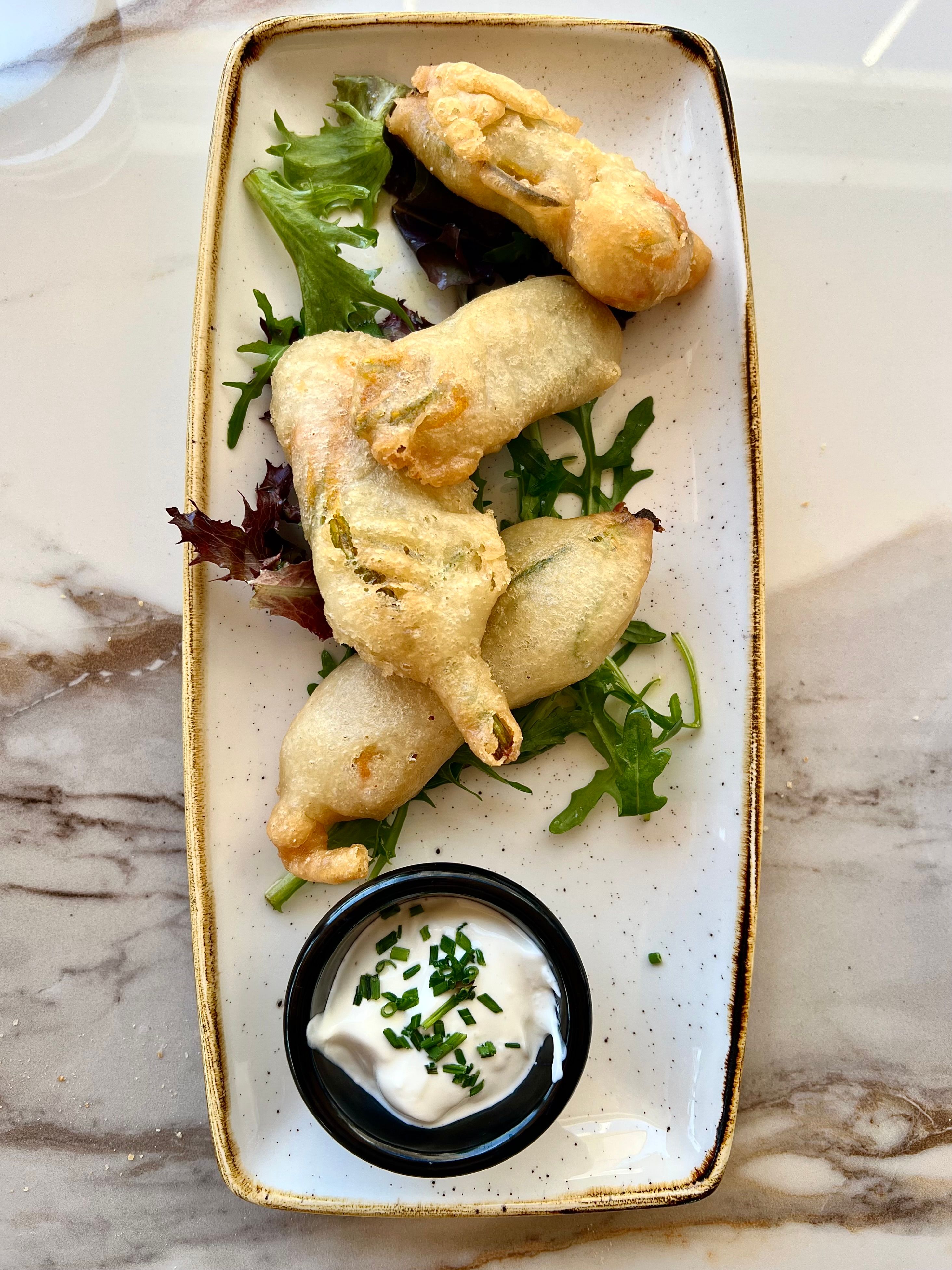
Every year around mid-May, a quiet war breaks out across Roman markets. The weapons are courgette flowers — fiori di zucca — those fragile, golden-orange blossoms that appear in wooden crates at Campo de' Fiori, Testaccio, and every neighbourhood mercato rionale from Prati to Garbatella. By 8am the best ones are gone. By 9am the vendors are telling you to come earlier tomorrow. By noon they've wilted into something no self-respecting Roman would fry.
Italy doesn't share this dish equally. Naples has its version. Sicily does something with them. But fiori di zucca fritti belong to Rome the way carbonara belongs to Rome — technically possible elsewhere, spiritually incorrect anywhere else. The Roman version is stuffed with ricotta and a single anchovy fillet, dipped in a light beer batter, and fried until the outside shatters and the inside becomes a molten, salty, creamy thing that you eat standing at a bar counter while it's still too hot to hold comfortably.
The two schools of filling
Walk into any Roman discussion about fiori di zucca and within thirty seconds someone will start an argument about the filling. There are two camps, and they do not compromise.
The first — and the one you'll encounter at most pizzerie al taglio and forni — uses mozzarella and anchovy. A small cube of fior di latte and half an anchovy fillet, tucked inside the blossom, twisted shut, battered, and fried. The mozzarella melts into long, stretchy threads. The anchovy dissolves into the cheese and disappears, leaving only salt and depth. This version is about texture: the snap of the batter, the pull of the cheese, the ghost of the fish.
The second — and the one we're making here — uses ricotta and anchovy. The ricotta doesn't stretch. It doesn't pull. It turns into a warm, creamy filling that holds its shape inside the flower. The anchovy stays more present here, its brininess sharper against the mild sweetness of the ricotta. You'll find this version at the older trattorie — the places that haven't changed their menu since 1974 and see no reason to start now.
Both are correct. Neither side will admit this.
Choosing the flowers
There are two types of courgette flower. The female flower grows at the tip of the courgette itself — it's smaller, attached to the vegetable, and generally used in pasta or risotto. The male flower grows on a long, thin stem directly from the plant. It's larger, more open, sturdier, and this is the one you want for frying. Look for flowers that are bright orange, slightly open (not wilted shut), dry to the touch, and free of brown spots or holes. They should feel like tissue paper — impossibly delicate but not limp.
Buy them the day you plan to cook them. They don't keep. If you must store them overnight, lay them flat between damp paper towels in the fridge. They will survive, but they will not be happy about it.
The beer batter question
Most Roman home cooks use sparkling water for the batter. It works. The carbonation creates lift, the ice-cold temperature prevents gluten development, and the result is a light, crisp shell. But beer batter is better — and here's why.
Beer brings three things that water cannot. First, carbon dioxide — same as sparkling water, creating air pockets in the batter that expand during frying. Second, alcohol — which evaporates faster than water, meaning the batter dries out and crisps more quickly, giving you a thinner, more delicate shell. Third, flavour — a light lager adds a barely perceptible malty sweetness that bridges the gap between the savoury anchovy and the floral sweetness of the blossom itself.
Use a pale lager. Something cold, cheap, and Italian — Peroni Nastro Azzurro or Moretti are both fine. Nothing hoppy, nothing dark, nothing with personality. The beer should be a team player, not a lead vocalist.
The recipe
Ingredients (makes 12)
- 12 male courgette flowers, stamens removed, gently wiped clean (do not wash them — water makes the batter slide off)
- 200g fresh ricotta, well-drained (leave in a fine sieve over a bowl for at least 1 hour, ideally overnight — wet ricotta is the enemy)
- 6 anchovy fillets in oil, halved lengthways
- Zest of half a lemon
- Freshly ground black pepper
For the beer batter
- 150g 00 flour (or plain flour)
- 200ml ice-cold lager beer
- 1 pinch of fine salt
For frying
- 1 litre sunflower or peanut oil
- Sea salt flakes for finishing
Method
1. Prepare the filling. Mix the drained ricotta with the lemon zest and a generous grinding of black pepper. Do not add salt — the anchovies provide all you need. The mixture should be thick and scoopable, not runny. If it's wet, drain it longer. Wet ricotta inside a fried blossom creates steam, which makes the batter soggy from the inside out. This is the most common mistake.
2. Stuff the flowers. Gently open each blossom and remove the stamen from inside (the spiky bit in the centre). Using a small spoon or piping bag, fill each flower about two-thirds full with the ricotta mixture. Tuck half an anchovy fillet alongside the ricotta. Twist the petal tips gently to close — they don't need to be sealed, just loosely shut so the filling doesn't fall out during frying.
3. Make the batter. Put the flour and salt in a bowl. Pour in the ice-cold beer and whisk briefly — ten seconds, no more. The batter should be lumpy. Visible flour streaks are fine. Overmixing develops gluten, which makes the coating tough and bready instead of crisp and shattering. The batter should be the consistency of single cream: thin enough to run off the flower in a smooth coat, thick enough to cling. Let it rest for five minutes in the fridge.
4. Heat the oil. Pour oil into a deep, heavy pot — you want at least 8cm depth. Heat to 175°C. Use a thermometer. If you don't have one, drop a small blob of batter into the oil: it should sink briefly, then rise and sizzle immediately. Too hot and the outside burns before the filling warms through. Too cool and the batter absorbs oil and turns greasy.
5. Fry. Hold each stuffed flower by the stem end and dip into the batter, turning to coat completely. Let the excess drip off for two seconds, then lower gently into the oil. Fry no more than three or four at a time — crowding drops the oil temperature. Cook for 2 to 2.5 minutes, turning once, until the batter is pale gold. Not deep brown. Not amber. Pale gold — the colour of a Prosecco. The blossom inside is delicate and you want to taste it, not just the coating.
6. Finish and serve immediately. Drain on a wire rack (not paper towels — they trap steam against the bottom and make it soggy). Hit them with sea salt flakes while they're still glistening. Eat within five minutes. This is not a dish that waits. A fiore di zucca that has sat on a plate for ten minutes is a completely different — and vastly inferior — object to one eaten thirty seconds after frying.
What to drink with them
Fiori di zucca are delicate. The filling is rich but not heavy. The batter is crisp but thin. The anchovy provides salt and umami but doesn't dominate. You need a drink that respects this balance rather than bulldozing through it.
- Prosecco — straight, cold, and dry. If you don't want bitterness at all, a good Prosecco Brut lets the flower speak for itself. The bubbles cut the oil, the acidity lifts the ricotta, and you stay out of the way.
- Select Spritz — slightly more herbal and less sweet than Aperol, Select adds a botanical layer that mirrors the vegetal quality of the courgette blossom itself. An underrated pairing.
- Vermentino — if you want still wine, a cold Vermentino from Sardinia or Liguria is your best option. Mineral, saline, just enough weight to match the fried coating without overwhelming the filling.
The default — and the one you'll see in every Roman bar — is an Aperol Spritz. The gentle bitterness and the orange sweetness sit alongside the blossom without competing with the anchovy, and the orange in the glass against the orange of the flower is its own small visual pleasure. Nine times out of ten this is what you want.
What to avoid: anything too bitter or too strong. A Negroni will flatten the delicacy of the flower. A Campari Spritz will overpower the ricotta. Cynar is wrong here — save it for something with more umami heft, like sarde in saor or aged cheese. The rule is simple: if the drink is louder than the food, you've chosen the wrong drink.
The Roman calendar
Fiori di zucca follow a strict seasonal rhythm that Romans treat as non-negotiable. The flowers appear in markets from late May through early October, peaking in June and July. This is when every pizzeria al taglio in Rome puts them in the display case. This is when the forni on every street corner stack them in rows behind the glass. This is when you eat them — not because you can't get courgette flowers from a greenhouse in February, but because doing so would be a kind of culinary dishonesty that Romans have no patience for.
The season is short. The flowers are fragile. The window between perfect and past-it is measured in hours, not days. And this is precisely what makes them worth the trouble — the same reason that aperitivo hour itself has boundaries. Constraints create meaning. A fiore di zucca in January is just a fried flower. A fiore di zucca in June, eaten at a Roman bar at 7pm with an Aperol Spritz sweating in your other hand, is a small act of seasonal devotion that this city has been performing for generations.