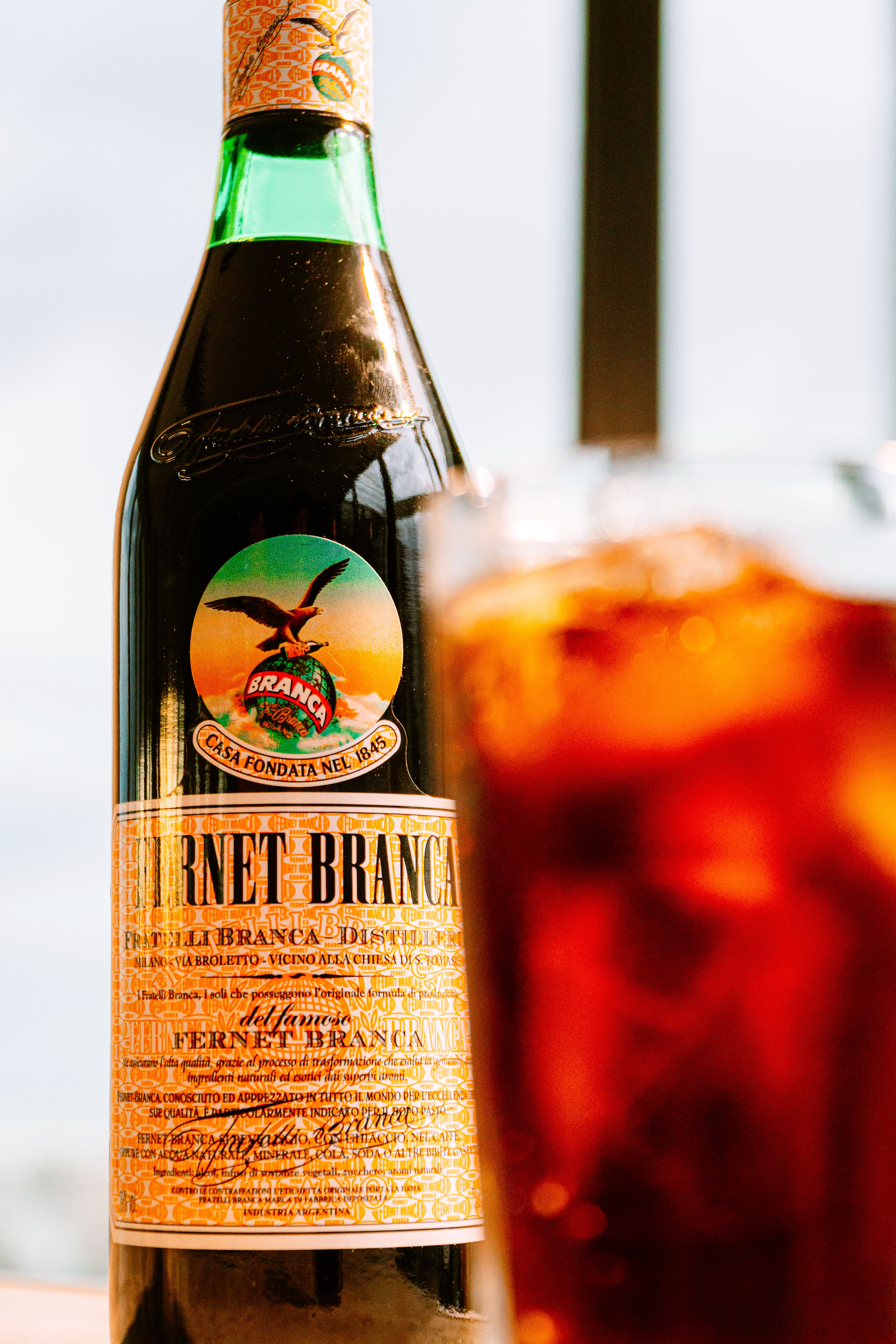
Fernet-Branca tastes like a pharmacy. It smells like menthol and wet earth and a church at Easter. The first sip makes most people pull a face that would be rude in any other context. And yet it has outlasted almost every digestivo of its generation, it is drunk in industrial quantities on the other side of the world, and bartenders in every major city keep a bottle behind the bar and raise small glasses to each other at the end of a shift. The bottle isn't trying to be liked — it's trying to settle the meal you just ate, and at that job it is unreasonably effective.
This guide is the case for actually drinking it — not once, on a dare, but properly, and in the three or four contexts where Fernet is the right answer and nothing else will do.
What Fernet actually is
Fernet is a style of amaro — a bitter Italian herbal liqueur — characterised by very high bitterness, very low sweetness, and a herbal profile driven by menthol, myrrh, saffron, and aromatic roots. Within the amaro family it sits at the far bitter end of the spectrum, roughly where Campari sits on the aperitivo end but darker, drier, and considerably more medicinal. If you want to place it, we covered the full family tree in our Italian amaro guide; Fernet is the aggressive final stop on that map.
Fernet-Branca is the original, and the benchmark. It was created in Milan in 1845 and is still made by the Branca family in the same city, now in its fifth generation. Other Italian producers make Fernet — Luxardo, Vittone, Sibona — and Argentina has its own serious Fernet industry now, but when people say "Fernet" in conversation, they almost always mean Fernet-Branca.
The founding myth, and the real story
The official company story is that Fernet-Branca was invented in 1845 by a Milanese herbalist named Bernardino Branca, working either alone or with a doctor called Fernet — variously described as Swedish or French, depending on which telling you read — whose name supposedly stuck to the bottle. The Dr. Fernet part is almost certainly invented — no record of him survives in either country — but the 1845 date and the Milan origin are well documented. The product was initially sold as a medicinal tonic, which in the 19th century was a very common way to sell alcohol without paying the taxes that applied to regular liquor. Branca's marketing at the time promised it could cure cholera, hangovers, menstrual cramps, indigestion, nervous disorders, and "the nostalgia of soldiers." None of these claims have ever been medically verified, though they have also never been formally retracted.
The real turning point for the brand was the arrival of Maria Scala, who married into the Branca family in the late 19th century and ended up running the company during the long period when the men were either dead, drafted, or not particularly interested in the business. She is the reason Fernet survived the early 20th century and the reason it crossed the Atlantic. Under her, the company opened distilleries in Chiasso (Switzerland), Saint-Louis (France), and Buenos Aires. The Argentine plant opened in 1941. It is still open. It produces more Fernet than Italy does.
The 27 botanicals
Fernet-Branca is made from a recipe of 27 herbs, roots, barks, and spices sourced from four continents. The exact formula is kept in a safe at the Milan distillery and has reportedly been known to only one person at a time in each generation of the Branca family — currently Niccolò Branca, the company's fifth-generation president. The family's own telling holds that he personally weighs the botanicals each morning. This is excellent marketing, and also probably at least partly true.
What is publicly known about the botanical bill is this: myrrh from Yemen or Somalia (the dominant aromatic), saffron from Iran or Sardinia (the reason Fernet-Branca costs what it does — saffron is the most expensive spice per gram in the world), chamomile from Italy and Argentina, cardamom from India or Sri Lanka, aloe ferox from South Africa, rhubarb from China, gentian from the Alps, bitter orange peel from the Mediterranean, cinchona bark from Peru, and galangal root from southeast Asia. A further sixteen or seventeen ingredients remain undisclosed. The botanicals are macerated in grape-based spirit, then aged for a minimum of twelve months in Slavonian oak casks before bottling at 39% ABV.
On the palate the menthol registers first — a cooling hit before anything else has a chance to arrive — then a wall of bitterness from the gentian, rhubarb, and aloe, with the saffron and chamomile doing something floral underneath it. Myrrh and galangal pull the whole thing down into a dark, earthy register, and the finish is faintly smoky. First-time drinkers almost always reach for the words "mouthwash" or "cough medicine," and they aren't wrong: both products draw on a similar botanical tradition. Fernet just got there first, by about eighty years.
Why Argentina drinks more Fernet than Italy
This is the single strangest fact in the Italian spirits world. Argentina, a country of about 46 million people, consumes roughly 75% of all Fernet-Branca produced globally. In Italy, Fernet is an occasional thing — a cold shot after a heavy meal, a quiet handshake between bartenders. In Argentina it is a household staple, showing up at every price point, at every kind of gathering, and almost always mixed with Coca-Cola in a drink called Fernet con Coca — known affectionately as a Fernandito.
The standard serve is roughly one part Fernet to three parts Coke, poured over a lot of ice in a cut-open 1.25-litre Coke bottle with the top removed, and shared among a group. The cola tames the bitterness and the Fernet kills the worst of the cola sweetness, which turns out to be a much better trade than it sounds. In Córdoba, the spiritual home of Argentine Fernet culture, a Fernandito is the default drink at a barbecue, a wedding, a football match, and a Tuesday afternoon. The phrase "un fernet, por favor" in a Córdoba bar will produce a Fernandito by default; if you want it straight, you have to specify.
The how-it-got-there story is about Italian emigration. Argentina was one of the two great destinations of the Italian diaspora — the United States was the other — and between 1870 and 1930 roughly three million Italians arrived in Argentina. They brought the bottle with them. Today around 60% of Argentines trace some ancestry to Italy, a proportion higher than any other country outside Italy itself. What made Fernet stick, rather than fade like so many emigrant traditions, was the combination of the 1941 Buenos Aires distillery, the arrival of Coca-Cola in Argentina the following year, and a generation of Córdoba teenagers in the 1980s who decided the combination was theirs. Today roughly 90% of the Fernet made in Argentina is consumed domestically. A separate batch of the Italian formula is still imported from Milan for purists, but almost nobody can reliably tell them apart in a blind test.
How to actually drink it
There are four respectable ways to drink Fernet, and two disasters to avoid.
Straight from the freezer, after a heavy meal
This is the Italian default and the version that converts sceptics. Keep the bottle in the freezer (39% ABV will not freeze). Pour about 30ml into a small chilled glass — an espresso-sized cordial, or a tiny tulip. Drink it in two or three sips over a minute. The cold blunts the bitterness and the menthol clears your head. Whatever the herbs are doing after that, Italians seem confident about it. After a long dinner with wine, a cold Fernet will do something no espresso or glass of water can manage.
Fernet con Coca (the Fernandito)
One part Fernet, three parts cold Coke (original — Coke Zero does not work, the sweetness structure is different). Lots of ice. Tall glass or a tumbler. No garnish. Stir once. Drink slowly. This is the beginner's Fernet and also, once you accept it on its own terms, the long-term drinker's Fernet too. The Córdoba heresy of cutting the top off a 1.25-litre bottle and making it communal is optional but recommended at least once.
Fernet and ginger
A San Francisco invention that became the accidental second-wave Fernet cocktail. 45ml Fernet, 90ml good ginger beer, lime wedge, tall glass, lots of ice. The ginger does some of the work the Coke does, but drier. This is what bartenders drink when they want a Fernet but also want to look like they are drinking something.
The Hanky Panky and the Toronto
If you want to put Fernet into a proper cocktail, there are two historical options that both work. The Hanky Panky (45ml gin, 45ml sweet vermouth, 2 dashes Fernet, stirred, served up with an orange peel) was created around 1921 at the American Bar of the Savoy in London by Ada Coleman, the hotel's head bartender, for the actor Sir Charles Hawtrey. On tasting it, he is supposed to have said "By Jove, that is the real hanky-panky!" The name stuck. The Toronto is a Canadian riff on the Old Fashioned: 60ml rye whiskey, 7.5ml Fernet, 7.5ml demerara syrup, two dashes Angostura bitters, stirred over ice and strained over one large cube, finished with an expressed orange peel. Both drinks use Fernet in a small supporting role, which is where Fernet performs best in cocktails. Two dashes can flip a drink from ordinary to memorable; 30ml will usually just taste like Fernet with background music.
What not to do
Do not make a Fernet Spritz. We love a spritz on this site — we have written about six of them — but Fernet's profile is wrong for the format. The bitterness is too aggressive for Prosecco's sweetness to soften, and the menthol dominates at the top of the glass instead of integrating the way Aperol or Campari does. And do not drink it warm. Fernet at room temperature is twice as bitter as Fernet at 0°C, and it is already sitting near the top of the bitterness scale.
The bartender's handshake
If you are ever in a good cocktail bar and the bartender, at the end of your evening or at the end of their shift, pours a small measure of Fernet and slides it across the bar without charging you for it, this is an informal tradition called the bartender's handshake. It took root in San Francisco in the early 2000s — by 2008 the city was reportedly drinking a quarter of all the Fernet sold in the United States — and it spread outward through the cocktail revival of that decade. The idea is that Fernet is the drink bartenders drink on their own time: too bitter to be requested casually by a stranger, so if you order it, or accept one offered, you are signalling that you know what it is, and the pour becomes a kind of professional courtesy. Accept it with a nod and a quiet "salute," and drink it in one. Try not to make a face.
Does it actually settle your stomach?
This is the question everyone asks and nobody has a rigorous answer to. Several of the botanicals in Fernet — chamomile, gentian, bitter orange, rhubarb root — have long traditions of use as digestive aids in European herbal medicine, and there is some peer-reviewed evidence that bitter compounds (the general category, not Fernet specifically) can stimulate saliva and gastric acid production, which can in principle help digestion. The 39% ABV is also doing something: small amounts of strong spirit after a heavy meal can accelerate gastric emptying.
Whether 30ml of Fernet actually settles your stomach, after your specific four-course dinner, is probably going to depend more on the dinner and on you than on any property of the liqueur. But Italians have been ending meals this way for roughly 180 years and show no sign of wanting to stop, and the cold-bitter-aromatic combination does genuinely seem to help. Treat it as a ritual and it behaves like one.
Where to buy it
Fernet-Branca is sold almost everywhere — any decent off-licence, most supermarkets in Europe, and the spirits aisle of any American liquor store. A 700ml bottle costs around €22–25 in Italy and £25–30 in the UK. It will last you a very long time, because unless you are in Córdoba you are drinking it in 30ml measures after dinner, not in pint glasses at a barbecue. The bottle is indestructible, the liquid does not degrade, and a single bottle will outlast most of the wine you buy alongside it.
If you want to try the other end of the Fernet category, Branca also makes Brancamenta — a sweeter, mintier, lower-ABV (28%) version first introduced in the early 20th century and loved particularly by Italian nonne. It is to classic Fernet what a candy cane is to a eucalyptus leaf. Start with the original; earn the right to the Brancamenta.
One bottle, four uses
If you are building a serious Italian spirits cabinet, Fernet is one of the five bottles we'd put on the essential list, alongside Campari, a good sweet vermouth, Prosecco, and either Aperol or Select. Of those five, Fernet is the one that most rewards patience. First-time drinkers rarely love it, and it isn't unusual to still be on the fence after your fifth glass. But if you stick with it — cold, small measures, after food — somewhere between the tenth and twentieth time the flavour clicks, and you understand what everyone has been going on about for 180 years. Put a bottle in the freezer and give it a season. It'll keep.