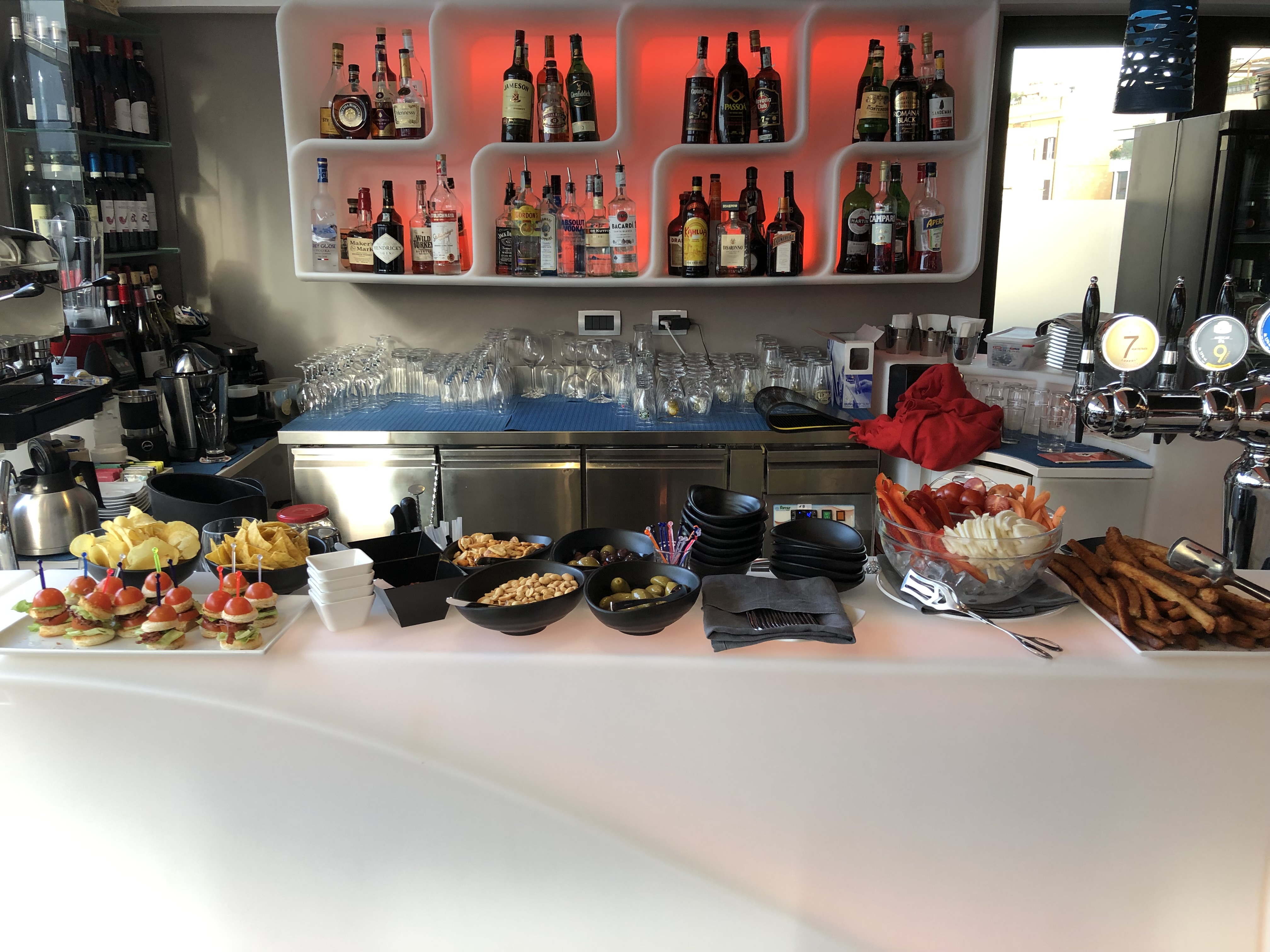
An American couple sat down at a table on Piazza Navona last June and ordered two cappuccinos. The bill came: €18. They photographed it, posted it online, and several thousand people called it a scam. It wasn't a scam. It was the system working exactly as designed — they had simply ordered the same drink, at the same bar, at a price that was four times higher than if they had walked ten metres to the counter and stood up to drink it.
This is the rule that visitors find hardest to accept about Italian bars: every drink has two prices. One for standing at the bar. One for sitting at a table. The gap is sometimes small (€0.30) and sometimes enormous (€4 or more on a tourist piazza). It is not hidden, it is not illegal, and it is not negotiable. It is also not something you need to be afraid of, once you understand what's actually happening.
The two prices, in practice
At a regular Roman neighbourhood bar — not a tourist piazza, just a normal bar where people get their morning coffee — the prices look something like this:
- Espresso: €1.10 standing, €2.50–€3 sitting
- Cappuccino: €1.50 standing, €3.50–€4.50 sitting
- Aperol Spritz: €5–€6 standing, €8–€10 sitting
- Glass of house wine: €4 standing, €6–€7 sitting
- Small bottle of water: €1 standing, €3 sitting
On a major tourist piazza — Piazza Navona, Piazza San Marco in Venice, around the Duomo in Florence — the table prices go higher again. €7 for an espresso at a table on Piazza Navona is normal. €15 for a Spritz at a table next to the Trevi Fountain is normal. The bar is not robbing you. The bar is charging you rent for the view and the chair, on top of the drink.
Why two prices exist
The two-tier system isn't a Roman invention or a tourist-trap convention — it's written into Italian commercial law. Bars are required to display two prices for every menu item: the prezzo al banco (counter price) and the prezzo al tavolo (table price). The list, called a listino prezzi, has to be visible to customers. Most bars print one near the till and one near the seating area. If it isn't displayed, the bar is technically operating outside the rules — though enforcement is patchy.
The reason for the gap is straightforward: table service costs more to run. A standing customer takes thirty seconds to drink an espresso and leaves. A seated customer takes thirty minutes, occupies a chair, uses a waiter's attention, eats the bread, drinks the water, and prevents someone else from sitting there. The price difference pays for that real cost. It also incentivises the rhythm Italian bars actually want — fast turnover at the counter, slow turnover at the table, both priced accordingly.
What makes the system feel exploitative to visitors is that the gap can be very large, and the moment of commitment happens before the price is visible. You sit down. The waiter brings the menu. By the time you read the table prices, you've already chosen a seat and the social cost of getting up and leaving feels higher than just paying the markup. This is true everywhere in the world. Italy is just unusually honest about it.
Three more rules tourists don't expect
Pay first, drink second
Most traditional Italian bars work in a specific order: you decide what you want, you go to the till (la cassa), you pay, you receive a small printed receipt (uno scontrino), you take the scontrino to the counter, you put it down, and the barista makes your drink. The scontrino is not optional. It's how the barista knows you've paid. It's also how the tax authority knows what was sold. Bars that don't issue scontrini are doing something illegal, and a customer can technically be fined for leaving without one — though in practice nobody enforces this against tourists.
At table service, this doesn't apply. The waiter takes your order, brings your drinks, and brings the bill at the end. But at the counter — pay first. Always. If you stand at the counter and try to order without paying first, the barista will either send you to the till or, in friendlier bars, ring it up at the counter and hand you the scontrino along with your espresso.
The barista decides where you stand
At a busy Roman bar at 8am, the counter is six people deep and there is no queue. There is also no need to push. The way it works: you stand somewhere near the counter, you make eye contact with the barista, you say what you want, and you wait. The barista keeps the entire order in their head — yours, the four people next to you, the person who arrived after you, all of it — and delivers each drink to the right person without writing anything down. This is a skill. Respect it. Do not order while looking at your phone. Do not try to wave them down. Do not assume they've forgotten you. They have not forgotten you.
You don't tip, but you round up
Italians do not tip in the American sense. There is no percentage. There is no expectation. At the counter, you might leave the small copper coins from your change in the little dish next to the till — €0.10, €0.20, whatever. At a table, if the service was good, you might round the bill up to the nearest euro or two. €23.40 becomes €25. That's it. Nobody adds 18%. Nobody calculates anything. Anyone telling you "tipping in Italy is X percent" is wrong, including most American travel guides. Round up if the service deserves it. Leave the bill exactly as printed if it doesn't. Both are fine.
When to sit, when to stand
The decision is mostly about what you're trying to do. There's no right answer, but there are three useful patterns.
Stand for the quick coffee. Espresso, macchiato, cornetto in the morning. Italians have a coffee at the counter five times a day. Most of those visits last under two minutes from walking in to walking out. Standing is faster, cheaper, and it matches the social tempo of the drink — coffee is meant to be brisk. A cappuccino taken at the counter on a Tuesday morning costs €1.50. The same cappuccino at the table at the same bar costs €3.50. Same cappuccino. Same milk. Different chair.
Sit for the aperitivo. The whole point of an aperitivo is to slow down between work and dinner. A Spritz is meant to last forty-five minutes. If you're going to spend forty-five minutes at a bar, you may as well sit. The table price for a Spritz is higher, but you're paying for the chair-time, and that's exactly what the drink is for. The exception: Milan and Venice, where standing at a packed bacaro counter during apericena hour is the actual local ritual. We covered the regional logic in our aperitivo hour guide.
Sit on the piazza only if you actually want the piazza. Tourist piazzas charge a premium for the view. Sometimes the view is worth it. A €15 Spritz at sunset on Piazza Navona, with the obelisk lit up and the swallows turning overhead, is a thing many people consider a reasonable use of €15. A €15 Spritz at the same piazza at 2pm on a Wednesday in February, when the piazza is grey and crowded with school groups, is harder to justify. The variable here is what you're buying — and you are mostly buying the piazza, not the drink.
The bars that don't follow the rules
Two kinds of bar break the model.
The first is the modern speciality coffee bar — the kind with a Slayer machine, single-origin beans, and a barista in a denim apron. These bars often charge counter prices regardless of where you sit, partly because they want to encourage you to linger and partly because their margins on a €4 pour-over don't have room for a table markup. You'll find these in Trastevere, in Pigneto, in the centre of most major cities. They are excellent. They are also not what an Italian means when they say "andiamo al bar."
The second is the bacaro and the cicchetteria — Venetian and Friulian standing-room bars where there is no table service because there are no tables. You order at the counter, the price is the price, you stand wherever you can find space, and you leave when your glass is empty. The whole structure makes the two-tier system irrelevant. There are no tables to mark up. Our cicchetti guide covers how to drink in these places.
The €18 cappuccinos
Back to the American couple on Piazza Navona. The bar that served them did nothing wrong. Their menu listed the table prices. The waiter brought the bill. The receipt was correct. The cappuccinos were probably mediocre — they almost always are at piazza bars where the customer turnover doesn't reward quality — but the price was accurate and disclosed.
The thing the couple didn't know is that they could have walked ten metres around the corner, into a bar called Sant'Eustachio Il Caffè, which sells one of the best cappuccinos in Rome at €2.50 standing. Or another twenty metres to Tazza d'Oro near the Pantheon, same story. The two-tier system in Italy isn't designed to trick visitors. It is designed to reward people who know how to use a bar — and one of the things you learn, after enough espressos at enough counters, is that the chair is almost never the part worth paying for.